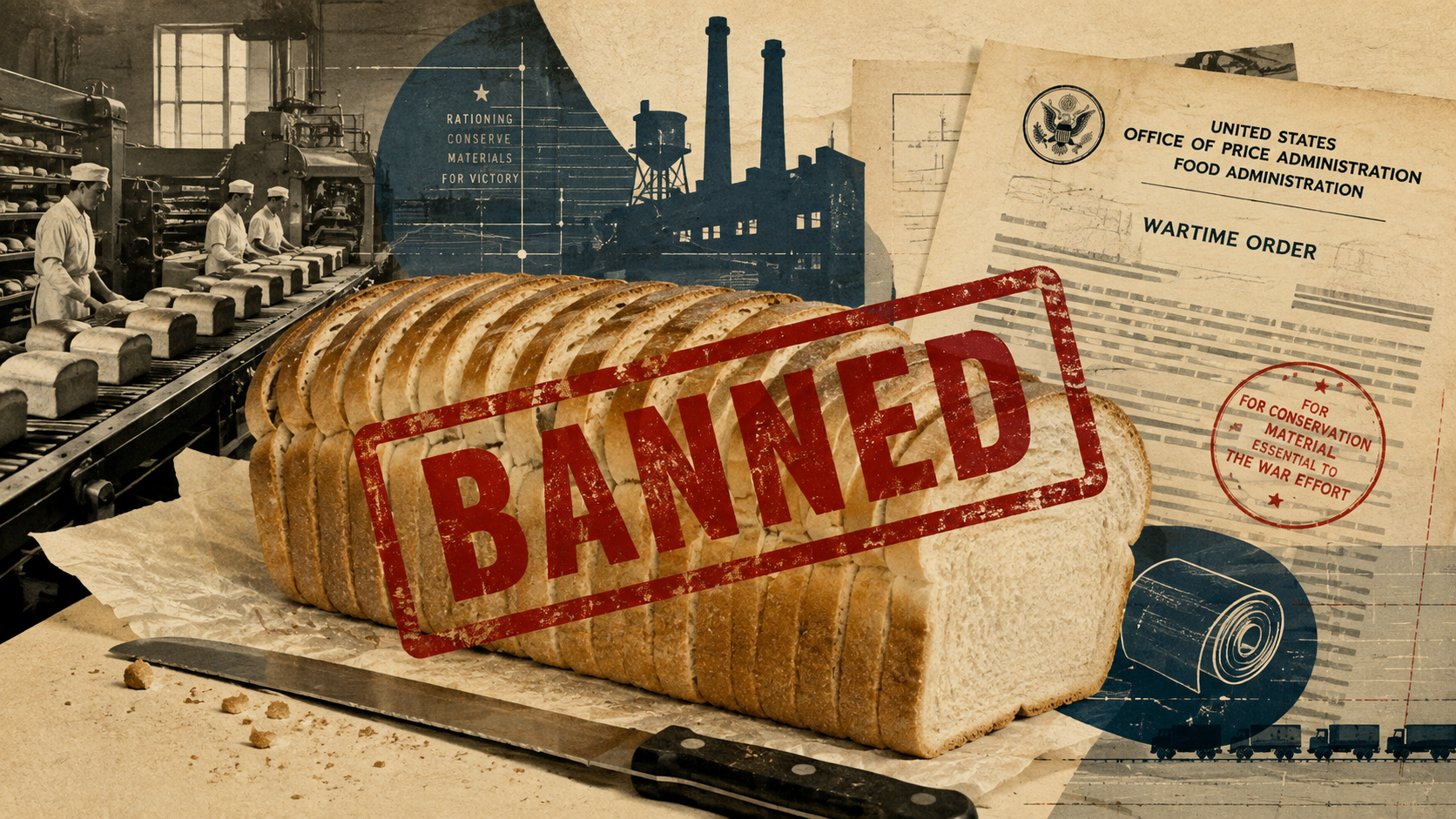
Sliced bread is ordinary now. For two months in 1943, it was a crime. On 18 January of that year, the United States told every bakery in the country to stop selling loaves that had been cut in advance, and almost nobody could give an accurate reason why. The device that made sliced bread possible belonged to Otto Rohwedder, an inventor bakers had written off — until he pulled off what the trade called impossible and spent his career trying to push the envelope of what a slicing machine could do. Scholars still argue about how much credit he actually deserves.
The prohibition, announced by Food Administrator Claude Wickard, was presented as a conservation measure: pre-sliced loaves demanded heavier wrapping in order to remain edible, and the wax paper involved was, in the government's accounting, a material better allocated to the war. What the announcement failed to anticipate was the scale of the objection that a two-cent convenience, once withdrawn, would prove capable of producing.
The official reasoning shifted more than once, buried in the same red tape that had produced the order in the first place: wax paper first, then the steel inside the slicing machines, then the price of a loaf — even though sliced bread had already taken off commercially, over a decade before the ban. The one thing the department never produced was a number showing how much any of it saved.
Even so, the order survived less than eight weeks. Housewives wrote to newspapers. One woman on Long Island worked out that her family was losing half an hour a week to a bread knife. By 8 March the rule was gone, withdrawn quietly, with no admission that it had ever been a mistake.
The machine behind all of it was already fifteen years old. Otto Rohwedder, a jeweller from Iowa, had spent ten years on a device that could cut a whole loaf into even slices in a single pass. A fire destroyed his prototype and his drawings in 1917, and he started again.
Bakers told him the idea was worthless: cut bread went stale within a day, and no shop wanted it. He found a fix anyway — holding the slices together with pins until wrapping machines caught up.
When Wonder Bread began selling pre-cut loaves in 1930, the product spread across the country in under two years. Historians still disagree about what exactly changed, and whether the machine created the demand or simply arrived after it.